Showing posts with label Military And Aviation. Show all posts

Saturday, May 22, 2010

IX- 812 Crash: Probable Reason and more

Saturday 22nd May was supposed to be a happy day for many indian families but it in fact turned out to be the biggest air disaster india has seen till date. Air India Express, IX 812, inbound Mangalore from Dubai overshot the runway and fell in the ravine at the end on the runway and burst into flames. As per reports, only 8 people survived with a casualty of 158 lives. Investigators are yet to examine the Flight data recorder( Black Box) which will clear the picture.


But what could have been wrong? The ATC says that the aircraft was looking good and no distress signal was relayed by the pilot or co-pilot. At around 6:03 AM,4 miles out , the ATC gave a "clear" on touchdown.The pilot acknowledged. That was the last communication with the aircraft. The aircraft was a boeing 737 which is a very reliable aircraft. Mangalore runway is a table top runway above a plateau and is 8000ft which is more than sufficient to land a 737 liner.So it clearly shows that whatever happened- it happened after the touchdown. 

Let's look at the landing of IX-812.... A typical airliner like 737 uses ILS for landing. For those who don't know about ILS- It stands for Instrument Landing System- ILS has 2 main parts- LOCALIZER: which aligns the aircraft with the runway and  GLIDE SLOPE:which determines the glide angle or the touchdown angle. In every sense ILS is an precision approach system and with the most sophisticated equipment it can guide you right down to the runway- zero Decision-Height and zero visibility. When IX-812 was landing the aircraft overshot it's actual touchdown point by 2000 ft.So the pilot has got only 5000ft to bring the aircraft to halt and taxi it on the tarmac. This means that pilot was too steep during the touchdown, which also means that aircraft speed was very high.Pilot must have realized that after touchdown.He must have deployed "Hard brakes". But because the angle of glide was too steep and speed was high, the tyres could not take that pressure and burst-ed. Aircraft went out of control and rolled in the gorge.

Ofcourse this is an assumption and we need to get the exact airspeed, weight of the aircraft and runway condition.

There are many things which you can do to maximize the chances of survival during air crashes :

1) Safest Seat: The rear portion of the aircraft is the safest. Many people think that the mid position is the safest. That's not true. The mid portion has wings and engines. Modern aircrafts store fuel in the wings. The mid section of the fuselage also holds the main fuel tank  and fuel pumps.

2) Emergency Briefings: I have seen many people laugh at stewardess during those briefings. Don't under estimate it. Before the aircraft takes to air..locate the nearest emergency hatch.Don't just make a visual snap. Remember the exit door by counting the number of rows of seats. Iam asking to do this because in most air crashes the fuselage will be full of fire, fuel and smoke. So you may not see the door clearly.

3)Clothing: Never wear synthetic cloths. They catch fire. Panty-hose have been known to melt right into a woman's skin. Wear shoes. 


Air transport is still by far the safest mode of transportation.


Monday, March 1, 2010

PAKFA, F-22A and F-35JSF: Hypothetical Combat Performance Evaluation

On January 29, 2010 Sukhoi Design Bureau's T-50 aka PAKFA took to the skies on a publicized test  flight .PAKFA literally means “ Future Frontline Aircraft System”.T-50 has been designed to replace MiG-29 and Su-27, so you can expect it to be super maneuverable. PAKFA is a closely guarded project and all the aspects of this aicraft are classified as top secret military information. India is also a partner in the program , though as usual india will have a customized version with indian,russian and hopefully israeli subsystems. It would be a direct compititor to F-22 Raptor and F-35 JSF Lightning II. People have already started discussing about PAKFA. Defence Discussion boards are packed and threads on F-22/F-35 Vs PAKFA are red hot. PAKFA will still need atleast 5 years to come into active service. 
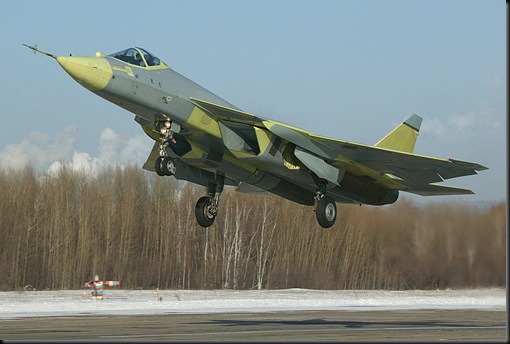
Sukhoi-T-50

Let me tell you a story- a hypothetical situation-

Our story takes place in Stockholm, Sweden. Three fighter pilots meeting in the bar at an air combat conference in Stockholm, in the year 2017.  Chuck is a US F-22A Raptor pilot based in Germany, Boris an Su-35-1 Flanker E Plus pilot flying from one of the bases protecting Moscow, and Johan, a F-35A Lightning II pilot from the Netherlands.  All are masters of their craft and after drinks, “merely to lubricate the vocal chords”, they do what fighter pilots all over the world do – swap stories and make claims about their beloved aircraft.

Chuck starts. “I’m king of the skies,” he claims. “I supercruise at 52,000 feet and Mach 1.7. Boris, I can see you from ~100 nm, and my AIM-120D launch range at this Mach is 70 nm. You are one dead Flanker.” Boris acknowledges the performance of the APG-77 and the Raptor, but replies, “Your missiles are easy to avoid. When you fire, my OLS-35 will see the flare, and I will turn away to out-run the missile.I will deploy flares and chaffs to confuse your missile seeker. You need to fire closer than 50 nm – even then at 50,000 feet and Mach 1.2, my Flanker can out-turn your missile. If you are side or rear on I can get a lock-on at ~40 nm and I have a choice of seeker heads, so you will get hit by an R-77M in the backside.” “No way Boris,” Chuck replies, “I know that game. I’m head on and you can’t see me until about ~15 nm. If I have not killed you at 50 nautical, I’m outa there at the speed of heat.” Boris and Chuck concede that there might be a nil-all draw, with Chuck being untouchable because of the Raptor’s stealth, altitude and speed and the well defended Su-35-1 defeating the Raptor’s missiles.

Now Boris makes his point. “Comrade Johan, I have something special for you. My IRBIS-E will see you head-on at ~25nm, but I fly my boys very wide and share the paints on our digital network. At side and rear looks, I see you at ~45 nm and my ramjet RVV-AE-PDs can get you at that range.” “No way”, Johan responds, “my APG-81 radar will see you at ~75 nm and I can launch at 50 nm. If you fire, my DAS will see the missile at launch, so I’ll turn away to break lock”. “And my wingman will see you in the turn, computer network will still know where you are” Boris’s replies, “and you will run out of missiles before I do, If I duck your AIM-120D shots, I will win easily”. They bicker about the strengths of their own aircraft and weaknesses of the other’s and Johan grudgingly agrees the Flanker might be the winner.

Chuck and Johan stay in the bar after Boris is unexpectedly ‘called away’ by men in dark coats, and agree that work needs to be done on improving the AIM-120D’s terminal lethality.

Essentially, this is a deadly play between stealth, agility, sensors and missiles. From the front quarter the Raptor’s 0.0001 square meter Radar Cross Section (RCS) and the Lightning II’s 0.001 square metres make them difficult targets. The Flanker-E Plus, while having a reduced radar signature, still has a residual RCS of about 2 square metres, such that the F-22A and the F-35 will see the Su-35-1 way beyond their missile launch range. The Su-35-1 struggles to see the F-22A on radar, but can find the F-35’s 0.01 square metre lower side and rear RCS. The AIM-120D is a fine missile, but the Su-35-1 has finer defences, so the missile kill probabilities are likely to be low. When out of missiles, the F-22 Raptor can escape. The F-35 Lightning II cannot.

A more likely future scenario is that Boris will be banned from subsequent air combat conferences, so we must rely on more conventional air combat operations analyses. If we move forward just a couple of years, say to the year 2019, and the PAK-FA is fully operational, there is a profound change in air combat engagements.Suppose the Russians don’t quite master stealth to the degree of the F-22A, but manage a RCS of 0.01 square metres from all aspects. The F-22A’s APG-77 will detect the PAK-FA at ~40 nm and the F-35’s APG-81 at ~30 nm. Passive electronic surveillance might increase detection ranges, but this still makes long-range missile shots problematic, as tracking depends upon the opponent emitting, which smart opponents will try not to do.The PAK-FA’s radar can be expected to be an improvement on the IRBIS-E so at front-on aspects might detect the F-22A at ~15 nautical miles and the F-35 at ~28 nautical miles; and from side and rear aspects, the F-22A at ~43 nautical miles and the F-35 at ~51 nautical miles.

Infrared sensors are the next growth area in air combat. Every air combat jet has unavoidable infrared signatures – converting kerosene into thrust . The existing OLS-35, developed for the Su-35BM, is credited with the ability to detect a ‘fighter type’ target head on from 27 nautical miles, and from behind at around 50 nautical miles, through a 90° sector. It uses conventional detector technology, and provides similar performance to the Eurofighter Typhoon PIRATE infrared sensor. It is likely the PAK-FA will have infrared signature management as is found on the designs of the YF-23A, B-2A and, but not on the F-35/F-22A (The AIRST was deleted from the F-22 avionic suite during development as a cost saving measure). QWIP(Quantum Well Imaging PhotoDetectors) based imaging Infra Red Search and Track (IRST) detectors can be “tuned” by design for sensitivity in a particular infrared band using a fundamentally different detection technique to conventional “band gap” detectors where the material determines the colour sensitivity of the detector. First commercialised by Germany’s AIM/Diehl-BGT, QWIPs have since been adapted for ballistic missile defence applications. QWIPs have also been built to operate not only in the “conventional” midwave and longwave infrared bands, but also in the “very longwave” 15 micron band to detect very cool targets. QWIPs capable of simultaneously imaging in two, three or four infrared bands have also been manufactured and marketed. QWIP technology, therefore, opens up the potential for even greater detection ranges against targets cooler than what current production infrared sensors can track, and provide for much better infrared background rejection.

Consider a QWIP technology “OLS-50M” installed in the PAK-FA. Such a device could be design-optimised for simultaneous detection and tracking of aircraft exhausts, jet-plumes and missile flares to ranges of 70 nm and beyond – the limiting factors are the size of the optics, cooling system and detector area. Russia has decades of experience in the integration of infrared sensors into its weapons systems, and QWIPs could well become the primary sensor and radar the secondary. This means that the F-22A AN/ALR-94 will be denied signals to detect and track the PAK-FA.

The ‘shooting match’ shifts from radar-centric to ‘infrared centric’. The problem here is that the PAK-FA will have it, the F-22A does not, and the ability of the F-35 EOTS and DAS to make long range aircraft detections and guide weapons is at best ‘unproven’. The F-35 systems have not been designed to be highly sensitive at the task of searching and tracking distant aircraft at those infrared colours where aircraft and their jet engines emit most of their infrared energy. An understanding of the physics, or for the ever-hopeful, a simple Developmental Test and Evaluation exercise will demonstrate this.With the Beyond-Visual-Range (BVR) radar detections being reduced to distances below 60 nautical miles and infrared sensor detection ranges growing beyond 50 nautical miles, a new generation of missiles will be required to dominate the battlespace. Russian missile companies have shown much more flexibility and adaptability in the design of missiles, so the PAK-FA could have a new-generation of shorter range, but higher agility missiles – a fusion of the ideas in the R-74 and R-77M, with a diverse mix of seeker heads.The Indian version of PAKFA will most probably have the option to fire israeli missiles which are highly agile,reliable and proven in combat These missiles will likely be cued by the IRST sensor, be equipped with inertial midcourse guidance and, probably, mid-course guidance update capability transmitted either by radio, or possibly infra-red laser or millimetric wave links.

Expect the PAK-FA to have 360 vectored thrust and high levels of agility like the Flankers ,it is to either replace or complement. Long missile range requires large rocket or ram-jet motors and these heavy weapons lack the agility to pull high terminal ‘G’, and may be ‘ducked’ by the PAK-FA as easily as by the Su-35-1.The PAK-FA will use a new super-cruising engine, based on technology from the Al-41F series, so its tactic might be to maintain combat speeds of about Mach 1.5 and use a more compact version of the ramjet RVV-AE-PD. A supersonic launch enables a ramjet to light without a powerful booster – thereby denying an opponent the detection of the usual missile launch flare. Fights between the F-22A and the PAK-FA will be close, high, fast and lethal. The F-22A may get ‘first look’ with the APG-77, but the PAK-FA may get an advantage using its advanced infrared sensor. Then, the engagement becomes a supersonic equivalent of the Battle of Britain or air combat over North Korea. The outcome will be difficult to predict as it will depend a lot on the combat skills of the pilots and the capabilities of the missiles for end-game kills. There is no guarantee that the F-22 will prevail every time.

The fate of the F-35 Lightning II would be far worse in an air combat environment challenged by the PAK-FA. If the Mach 1.5 PAK-FA is using its infrared sensor as the primary sensor and observes radio frequency emission control (EMCON), then the first detection by the F-35’s APG-81 radar could be at ~20 nautical miles or less with a missile launched by the PAK-FA’s infrared sensors already inbound from 60 to 70 nautical miles away. The PAK-FA could easily break to a direction outside the F-35’s AIM-120 engagement zone.The sustained turning performance of the F-35A Lightning II was recently disclosed as 4.95 G at Mach 0.8 and 15,000 ft. A 1969 F-4E Phantom II could sustain 5.5 Gs at 0.8 Mach with 40 percent internal fuel at 20,000 feet. The F-35 is also much slower than the 1960s F-4E or F-105D. So the F-35A’s aerodynamic performance is ‘retrograde’ when compared with 1960s legacy fighters. The consequence of such inferior JSF performance is that its DAS might detect an incoming missile, but the aircraft lacks the turn-rate to out-fly it. As the F-35 also lacks the performance to engage or escape, repeated ‘freebie’ shots from the PAK-FA could inflict high losses. Expect the exchange rate to be of the order of 4:1 in favour of the PAK-FA, possibly much higher[3].


NOTE:: I will write about QWIPs in seperate posts
Friday, January 29, 2010

Happy for ICG…

Two happy news:

1) India has decided to procure 145 M777 Light weight towed howitzers to boost up the artillery units. M777 is an ultralight field howitzer (UFH)which can be deployed very swiftly and operated with real ease in tight  fronts. The UFH can be deployed by helicopters, transport aircraft or ships and can be dropped in hot zones. This artillery system is already inducted by US army and Marine forces. The M777 has already been deployed in Afghanistan and Iraq. US forces have modified it’s software to fire the Excalibur smart shells.

Talking about firepower, it matches the firepower of current generation 155mm towed systems at less than half the weight.

If i can recall it correctly, Indian army has raised two mountain divisions to tackle china. 15000 soldiers are with each of these division. I am sure these divisions are to be equipped with M777.


M777_6


2) Indian Goverment is considering a 3 fold expansion of Coast gaurd with nest 10 years. The first phase will see installation of search radars on most of the light houses. The second phase will see the induction of coastal recon aircraft. Two options are to be considered-: Beriew Be-200 Multi role Amphibious aircraft, manufactured by Irkut corp, Russia. The second one is a turbo- prop from the stables of Bombardier.Q 200 from bombardier is an ‘quiet” aircraft if compared to normal turbo prop engines. Many people would say that why Indian Coast Guard is checking turbo prop( aren’t these old horses)..yes they are..but many people don’t know that turbo prob are really efficient in low and mid level altitude while jet engines are efficient in higher alttitudes.


Be-200

1031785

Q-200

800px-QantasLink_-_VH-QOJ_-_Bombardier_Dash_8_Q400


Iam really happy for the ICG, especially.Coast Guard is the force which has never been given it’s due importance.So it’s good to see some light there…good job..hope this plan solidifies.

Wednesday, May 27, 2009

French Navy in Abu Dhabi

They call it the peace camp but it's a full fledged military base in Abu Dhabi. On 26th may 2009 france officially opened it's first major military base in gulf. The base is a dedicated french navy dock to influence this oil rich part of the world. Ofcourse the occasion was important enough to attract french president Nicholas Sarkozy. Sarkozy says the Abu Dhabi base will be used to counter sea-piracy and security patrolling. But the important thing is that france already has a big base in Djibouti. Approx 500 navy personals will be based along with dedicated fleet of warships and aircrafts. Sarkozy also plans to build 2 nuclear reactors in UAE and to sell 60 Rafale Air Superiority Fighters.

US and UK already have their military bases in middle east. No doubt that france wants to play an important role in this part of the world.The region is close to current conflict zone of Afghanistan-Pakistan and probably iran .It;s also the region which includes the important sea trade routes. These routes account for 40% of the world oil supplies.

Tuesday, May 26, 2009

IAF Update: MidAir ReFuellers Compitition

Terminating an old stalemate with Russian defence industry, India today rejected IL-78 from IAF's midair refuller competition.IAF has decided that it will not field IL-78 tanker to keep it's fighters airborne for considerably longer timesThis marked the first major shift for indian defence forces.Till now Russia was the biggest weapons vendor to india but now things are changing and they are changing pretty fast.It all started with MiG accidents and india's pateince ran out with Admiral Goshkhov aircraft carrier and T-90 Main battle Tanks. Coming back to the original thread...after using IL-78 for last 6 years, IAF now selected Airbus 330 MRTT. Air force says that IL-78 could not meet the given parameters which are required for any "capable" 21st century air force. IL-78 and A-330 were both competing for the global tender for six mid-air refullers floated 3 years ago by ministry of defence.Air force has sent the recomendation to CCS for approval.

It would be logical to have a look at the A-330 refuller.Structurally it's similar to the normal Airbus-330, which is a popular passenger craft.Design and basic aerodyanamics is pretty much the same.Obviously the diffrences would be in avionics and internal load section.The airtanker is build by EADS- which leads a consortium which includes Thales,VT Aerospace and Rolls-Royce.The same consortium would be responsible for the manufacturing and servicing of the aircraft.It will also deal with the training of the pilots and aircrews. The aircraft has considerably high cruise speed..at around 920-50 km/hr. It can cover 4000km with single refuelling and can refuel six aircrafts. It can also carry 43tons of non-fuel cargo.It has a maximum fuel capacity of 111tons.The engines can either be GE or Rolls-Royce.

Wednesday, May 13, 2009

IMPORTANT UPDATE !

The commander of coalition troops in Afghanistan, U.S. Army Gen. David McKiernan, is being replaced by Army Lt. Gen. Stanley McChrystal.

David_D__McKiernan

Defense secretary robert gates says that it would be the start of fresh and new approaches to end the 8 year old conflict.Seems like US goverment is becoming really impatient about the chaos in Afghanistan.Damn! they must be remembering about CIA-ISI-Mujahedeen nexus during cold war. It is the same ground where they saw the beating of Soviet union.

Some background info about this new man is   essential. Gen Stanley is taking charge of the most dangerous place on our planet.And the situation cannot be bad than this.Tmcchrystalaliban is re-grouping and Pakistan is on the brinks of becoming a failed “nuclear” state.Allies are leaving this war but the US is about to boost the man power.


Sure this is a tough situation.

But there are few suggestions to the new general.

1) “Activate” your CIA sub-station in Islamabad. Tell the station chief to break in the tribes…cut the sleeper cells which are operating deep inside pakistan- offer whatever you can—sex..money..alcohol…anything.

2) Start Pressing into NWFP region right from South Waziristan to Khyber region. this will divide the NWFP into two parts.Neutalise the southern NWFP(meanwhile itz very important to build a strong defence at the border of Khyber-Peshawar-Nowsehra).Include this region into FATA and reinforce it.Smash any resistance…General U will have to forget human right fundas.

3) Once the southern NWFP is neutralized start pressing into northen part. Buner will be the first stop and it would be tough.Buner is a region which will remind you of vietnam and korea.Once Buner is captured don’t rush into SWAT(that would be a show spoiler).

4) Instead start pressing towards the east into Shangla..Manshera…Naran. Meanwhile your troops can comb the whole Buner area.I would suggest kill everyone there.And in the east, Indian army will load it’s guns to kill the fleeing militants from Shangla and manshera.They will try to sneak into Kashmir..but we would be ready to slaughter them.U will have a completely secure eastern flank.Don’t forget to share the intel with Indian forces.You don’t have to bring india into any ally group.They will kill these bastards into indian territory only.You just have to push them into there.

5) Press Dir and Chitral region from North west. You can easily do that. Most of the part of Chitral are inhospitable.

6) After all these..Press your attack into SWAT from 3 fronts…Southern Flank…Western Flank And Eastern Flank.Demolish SWAT so that it can never rise again.It’s the terrorist factory.Kill everyone there.

USER TRIALS FOR AGNI-II MISSILE

INDIA is preparing for a user's trial of surface-to-surface Intermediate Range Ballistic Missile (IRBM), Agni-II, from the missile test range off the Orissa coast this week. The indigenously developed missile will be fired from the launching complex-IV at the Wheeler's Island near Dhamra.Preparations are on in full swing. If everything goes as planned, the missile will be testfired between May 12 and May 14 at Chandipur-on-Sea. It also said the test may be deferred by four-five days if there are problems reported during the preparations. Defence Research and Development Organization (DRDO) scientists are excited because this user trial will pave the way for the maiden test of Agni-IV that is now under development.
The successful tests of 800px-Agni-II_missileAstra missile from the ITR have encouraged the scientists for user trial of Agni-II. They are doing everything to ensure it's a success story. This missile is part of the Integrated Guided Missile Development Program (IGMDP), while the other missiles include Prithvi, Trishul, Akash and Nag. Agni II has appropriate on-board thrusters fitted on the second stage of the missile. Both stages of Agni-II have a solid propulsion system which allows the missile to be mobile and flexible.It also reduces the operational hazard.The Agni-II missile, which is 20 metres long, has a diameter of one meter and weighs 16 tonne, can neutralize a target at over 2,000 km range. It can carry a payload of around 1,000 kg and its range can also be increased to 3,000 km depending upon the payload. The missile will be used by 555 Missile Group of the Indian Army. Agni-II can be fired from a rail-mobile launcher and is also available in road-mobile configuration. This lends flexibility and reduces vulnerability to first strike. It is in fact a ready-to-fire missile with a launch time of about 15 minutes. Agni-II, along with Agni-I and Agni-III form the triad of the country's minimum, credible, nuclear deterrence.

CVN-77 is War ready!!

Northrop Grumman Corporation delivered the newest and most advanced nuclear-powered aircraft carrier, USS George H. W. Bush (CVN 77) for US Navy, today. It is the 10th and final Nimitz-class aircraft carrier and was constructed by the company's Shipbuilding sector in Newport News, Va.I think dferthey made history by delivering 10 Nimitz class aircraft carriers. Those of you who are familiar with Nimitz carrier will know what i am saying. for others lemme’ tell that Nimitz carriers,till date, are the largest warships with a displacement of over 100,000tons. for comparison purpose our own INS Viraat aircraft carrier has a displacement which is somewhere around 29000tons.Huge difference!  CVN 77 represents the culmination of years of hard work,experience of carrier deployment n usage in war zone,craftsmanship and dedication by thousands of shipbuilders, whose work will remain with the fleet for the next 50 years.USS George H.W. Bush is the 10th and final Nimitz-class aircraft carrier constructed by Northrop Grumman Shipbuilding's shipyard in Newport News, Va. At 1,092 feet in length, USS George H. W. Bush is nearly as long as the Empire State Building is tall. It weighs 97,000 tons, can carry more than 80 combat aircraft and its top speed exceeds 30 knots. Powered with two nuclear reactors, it will operate for more than 20 years without refueling.
New design features for the USS George H. W. Bush include new propellers, a new underwater hull-coating system, an updated aviation-fuel distribution system, and modernized aircraft launch and recovery equipment. Environmental upgrades have also been designed into the ship, including a new marine sewage system. It is the second carrier to have a modernized island and a new bulbous bow design that provides more buoyancy to the forwfderw ard end of the ship and improves hull efficiency. The ship's keel was laid Sept. 6, 2003, it was christened Oct. 7, 2006 and was commissioned Jan. 10, 2009. The carrier carries up to 56 fixed-wing aircraft including the Hornet, F/A-18A,C,E and F, the Grumman EA-6B Prowler and the Grumman E-2C Hawkeye, and up to 15 helicopters, Sikorsky SH-60F, HH-60H Seahawk and SH-60B Seahawks.The ship carries a crew of over 6,000. But there would be 3,200 crew with 160 officers and 2,500 aircrew. The ship also accommodates the carrier battle group's flag officer and about 70 flag crew. The flight deck is 332.9m long and 76.8m wide. The angle flight deck is 76.8m long. The angled flight deck allows the landing aircraft the option of accelerating safely away if required, minimising the danger of colliding with stationary aircraft on deck. The carrier can launch aircraft at a rate of one every 20 seconds. The deck has four C13-2 steam catapults and three mk7 mod 3-type arrester wires.The carrier has four deck edge elevators. The deck edge elevators allow large aircraft to project over the side of the ship. Two starboard lifts are forward of the island and one is to the aft of the island, and the port lift is also aft of the island towards the stern. The hangar deck, (7.8m high) has capacity for up to about 30 aircraft, depending on the composition of air wing. The ship carries 8,500t of aviation fuel.Lockheed martin is the primary warfare system integrator for CVN 77. The CVN 77's combat data systems are based on the advanced combat direction system (ACDS) with communications Links 4A, 11, and 16. Weapons control is managed by three mk91 mod 1 MFCS directors for the Sea Sparrow missile.The ship is armed with two Raytheon GMLS mk29 octuple missile launchers and the Nato Sea Sparrow or Evolved Sea Sparrow missiles and two guided-missile launch system mk49 with the RIM-116 rolling airframe missile (RAM). The sensors part include The air search radars which is a ITT SPS-48E three-dimensional radar operating at E/F band, Raythecvn-77-Image2on SPS-49(Version)5 operating at C/D band, and Raytheon mk 23 TAS operating at D band. The ship's surface search radar is the Northrop Grumman Norden Systems SPS-67V, operating at G band. For countermeasures the ship is equipped with a Raytheon SLQ-32(V)4 interception and jamming electronic support and countermeasures system and a Nixie SLQ-25 towed decoy and signal generator set. The ship is steam powered, the steam being generated by the two General Electric (originally Westinghouse) nuclear pressurized water reactors type PWR A4W/A1G. The steam drives four turbines generating a total of 209MW, which drive four shafts. Four standby 8MW diesel engines are installed for emergency power.

This will surely add some relief to US defense forces as they are fighting a tough battle in Afghanistan.Kyrgyzstan parliament has voted to close the US air base.The incident will put pressure on US naval formations in Indian ocean Region(IOR) and Meditterean Region(MR)The lead ship of Nimitz class which is USS Nimitz (CVN-68) is about to retire. There were reports that this CVN-68 will be offered to Indian Navy minus the PW Nuclear Reactor.Indian navy is facing some tough times as Russia delays the delivery of Admiral Goshkhov re-christened by IN a INS Vikramaditya .If Nimitz is offered to India, it would be a logical and wise step to grab this ship…This will truly be a first step to become a powerful “blue water” navy.As a matter of fact conducting peace operations worldwide is different from having a global offensive-defensive reach.India needs to think this over.

Saturday, April 18, 2009

M-MRCA UPDATE (April, 2009)

The first phase of the technical evaluation is over and the results were really shocking. French built Dassault's Rafale is knocked out of the competition. Ministry of Defence(MoD, India) says that the aircraft fell short of meeting all the technical parameters.But i think the main reason is the cost of the aircraft. Rafale was the costliest contender. The overall budget for this deal is around $10 billion. With this, the M-MRCA competition is reduced to five contenders-


1) US F-16I Fighting Falcon from Lockheed Martin

2) US F/A- 18 E/F Superhornet from Boeing

3) European Consortium EADS's Eurofighter Typhoon

4) Russia's MiG-35 from Mikoyan Gurevich

5) Sweden's Grippen from SAAB


The field trials are expected to start from next months. There's high probability that two sets of trials would be taken- each in Low temperature areas of Leh, High temperature areas of Jaisalmer and Humid areas of south India(bangalore). Field trials and subsequent evaluations are time consuming process and this deal won't be inked before 2010.

Monday, March 23, 2009

TAV-21 TAVOR ASSAULT RIFLE

I was checking out the pics of AERO INDIA-09 and one of the interesting pic i saw was that of an Army's Para Maroon Beret(Army's Special Forces Unit) standing in vigil with a TAVOR Assault Rifle. Now this was a good sight partly because this is after a long time that government has actually decided to de-commission those old WW2 era sten guns and finally we have some assaultder rifle for our special forces which is build for them .Now this also demands some introduction to Tavor.  The story starts when India signed a Rs. 880 million deal with Israel Military Industries for 3070 TAR-21 Tavor assault rifles, a new bullpup design developed for use by the Israeli Defense Forces. The Israelis had just selected the compact Tavor over the Colt M4/M16 as its next-generation assault rifle, and the compact new weapons would be issued to India’s special forces personnel, where its ergonomics, reliability in heat and sand, and and fast-point/ fast-shoot design might give them an edge in tavor_02close-quarters shootouts and employment from inside vehicles.

Bullpup designs though unusual are pretty effective in close-quarter attacks where agility, weight and pin point firing is very necessary.Tavor has a small design which enables the person to take defensive-t0-evasive actions within few seconds.It has a laser targeting sight to assist with the firing.The Tavor TAR-21 is a gas operated, selective fire, magazine fed assault rifle of bullpup configuration. It is available in several configurations which differ in the barrel lengths and accessories. The basic configuration is the TAR-21 assault rifle with the 460mm (18.1 in) barrel. Next are the compact assault rifle, called CTAR-21, with the barrel 380 mm (15 in) long, and the micro assault rifle, with the barrel of only 330 mm (13 in) long, called MTAR-21. tavor_03 The latter rifle also featured a redesigned front part of the housing, with charging handle placed further back on receiver  for a more  comfortable hold of the short weapon. Micro-Tavor also can be converted to 9mm pistol ammunition (9x19) with installation of the caliber conversion kit, which includes a new barrel, bolt group and a magazine adapter.tavor_05
TAR-21 utilizes a common long piston stroke, rotating bolt action, with the gas piston rigidly attached to the bolt carrier. Gas cylinder is located above the barrel and is completely enclosed by the gun housing. The rotating bolt is similar to one found in the M16 rifle and has seven lugs. The ejection ports are made on both sides of the weapon, and the right or the left side ejection can be selected by installing the bolt with the ejector mounted on the right or on the left, respectively (and of course this change requires the gun to be partially disassembled). The bolt carrier rides on the single guide rod, with the return spring unit located above it, behind and inside the hollow gas piston rod. The charging handle is located at the front left side of the gun and does not reciprocate when gun is fired. The charging handle slots are cut on the both sides of the gun housing, so it can be installed on either side of the weapon, as required. The trigger unit is more or less conventional, with the ambidextrous fire mode selector / safety switch located above the pistol grip.
The TAR-21 has no separate receiver. Instead, all parts are mounted within the high impact-resistant plastic housing, reinforced with steel inserts where appropriate. The access to all the internal parts is controlled by the hinged buttplate, which can be swung down for internal inspection and disassembly.
Early production TAR-21 rifles had no open sights, but this has been fixed with introduction of the folded front and rear sights on current production models. Tavor rifles are fitted with the standard Picatinny-type accessory rail on the top of the gun. Early guns had Israeli-made ITL MARS as standard sight, which is a complicated and expensive reflex-type sight with the built-in laser pointer. For the night time operations the MARS could be complemented with the ITL Mini N/SEAS compact night vision device. Current manufacture Tavor rifles (except for Sniper version) are usually fitted with less expensive Meprolight red-dot sight. Sniper varsions usually are fitted with Trijicon ACOG optical sight with 4X magnification.
The TAR-21 utilizes the STANAG-compliant, M16 type magazines, with standard capacity of 30 rounds.
TAR-21 in its basic configuration can be fitted with 40mm M203 underbarrel grenade launcher.


  TAR 21 TAR C21 / CTAR 21 TAR M21 / MTAR 21
CALIBER 5.56 X 45 NATO STANDARD 5.56 X 45 NATO STANDARD 5.56 X 45 NATO STANDARD
ACTION GAS OPERATED, ROTATING BOLT GAS OPERATED, ROTATING BOLT GAS OPERATED, ROTATING BOLT
OVERALL LENGTH 720 mm 640mm 590 mm
BARREL LENGTH 460 mm 380 mm 330 mm
WEIGHT 3.27 kg empty 3.18 kg empty 2.95 kg empty
MAGAZINE CAPACITY 30 Rounds 30 Rounds 30 Rounds
RATE OF FIRE 750-900 Rounds/min 750-900 Rounds/min 750-900 Rounds/min

Wednesday, January 21, 2009

M-MRCA Update-2009

The Massive M-MRCA deal for the Indian Air Force(IAF) has completed one more important step.The initial techinal evaluations are completed last month and all recomendations and reports have been forwarded to defence ministry. It's a massive deal and almost all compititors know the importance of the deal.It will not only give present business prospect but will also open huge oppurtunities for joint ventures, joint research and co-production. Lots of things are going over the electronic media bout the deals. There's also a update flying around which says that grippen is out of the compitition. That is not true. Apparently VayuSena Bhavan( IAF HQ) have forwarded all the compititors with out any eliminations. That means the field trial of the aircrafts can be expected to start from March-April , 2009 . Field trials will be done under Hot Conditions(in Rajasthan or Kutch) and extreme Cold conditions( in Leh), along with trials in Humid Conditions(Shore base).

Tuesday, January 20, 2009

A Quatum Leap In Naval Recon/ASW

The year definately started with a good note for indian armed forces..first it was the implementation of sixth pay commision hike and the decision to establish a seperate pay commision for armed forces. Indian armed forces are also recieving modern warfare equipments, thanks to the country's high economic growth rate.Last week i wrote about the induction of Phalcon Condor AWACS system into Indian Air Force. Indian Navy is also going for the fleet modernisation program and the latest development is that india inked a $2.1 billion deal with Boeing for the supply of 8 customized P-8A Poseidon Maritime Multimission Aircraft (MMA), designated P-8I, for use by the Indian Navy.Considering that india has a huge coast line and the incidents in last few months have firmly establisbed the fact that india's interests are , in fact , outside its 12 mile coastal zone.Recent engagements at Somalian coast and Recent mumbai attacks have highlighted the importance of a true "Blue-Water Navy" with advanced and long range martime survillence and recon. The deal is the biggest ever defense deal between India and the US, surpassing the 2007 $962 million deal for the supply of six C-130J `Super Hercules' aircraft for Indian special forces. Hercules was primarily inducted for the use of transportation of Special forces(SF) and will be used as tactical transport.India will get its first P-8I towards end-2012 or early-2013, with delivery of the remaining seven aircraft expected to be completed by 2015-16. Under the contract India has an option to order four to eight more such planes, which , i think india will order.


P-8I will replace Indian Navy's agining Tu-142 Bomber/Recon. But iam sure that navy would want to squeeze Tu-142 till 2015. Tupoluv's have recently gone through a upgrade program in russia and the new Sea-Dragon suite has been integrated into the aircraft.The P-8I Poseidon will help the Indian Navy keep a tab on Chinese nuclear submarines lurking around India. India, along with Australia, is amongst the first foreign buyers of the Poseidon system, which is yet to be inducted into the US Navy. Capable of extended broad-area and littoral MR/ASW operations for ten hours at a stretch, the P-8I MMA uses Boeing’s B.737-800 airframe, is powered by twin CFM56-7 turbofans each rated at, 27,300lb of takeoff thrust, and its wings will feature commercially proven raked or backswept wingtips. The P-8I MMA will be equipped with a mission avionics/sensor suite comprising:


* Northrop Grumman’s electro-optical/infra-red (EO/IR) sensor, the directional IR countermeasures system, electronic support measures system, secure data link, and mission-planning support hardware.


* Raytheon’s upgraded APY-10 maritime surveillance radar and signals intelligence (SIGINT) solution; a GPS anti-jam, integrated friend or foe, and towed decoy self-protection suite; a broadcast information system (BIS); and secure UHF SATCOMS capability.


* Smiths Aerospace’s flight-management and stores-management systems.


Flight-test delivery of the first P-8A MMA is slated for 2009, with initial operational capability and series-production following by 2012. Elsewhere in East Asia, other prospective customers of the P-8A MMA in future could include Australia, Indonesia, Japan, Malaysia, New Zealand, South Korea and Taiwan.

Saturday, January 17, 2009

Phalcon Condor Reaches India

The year started with a good news for Indian air Force. Israel has dispatched the first of the three Phalcon Airborne Warning and Control System (AWACS) aircraft to India ahead of a reworked delivery schedule. The aircraft arrived at New Delhi's Palam airport on 11 January 2009 from where it has now moved to the Indian Air Force's base at Agra.
The surprise development takes place even as relations between India and Pakistan continue to deteriorate post-Mumbai terror attacks. According to the re-worked delivery schedule the first Phalcon was to arrive only in February 2009.Under a $1.1 billion deal signed in March 2004.Israel was contracted to supply three Phalcon airborne warning and control systems. These systems were to be mated with Ilyushin-76 heavy military transport aircraft. The deliveries were originally intended to commence in November 2007, but were subsequently postponed to the end of 2008 and further to February 2009.


India may have contracted for a fourth Il-76 mounted Phalcon AWACS system from Israel. It is said to be keen on building up its Phalcon AWACS fleet to a strength of six.
The Israeli Phalcon AWACS will enable the IAF to carry out tactical surveillance over a radius of 400 kilometers and collect surface target information deep inside Pakistan even as the aircraft operates within Indian airspace. An electronically steered beam emitting from a solid-state phased array Elta EL/M-2075 radar, mounted on a radome above the fuselage, provides a 360 degree coverage around the aircraft.It is also being suggested that the AWACS will eventually be networked with other air force assets through a dedicated satellite.India has an indigenous AWACS programme being developed by the Defence Research and Development Organisation (DRDO), which signed a deal last year with Brazilian aircraft manufacturer Embraer for the purchase of three EMB-145 aircraft for use as an AWACS platform. These aircraft will be modified to carry an Active Array Antenna Unit, developed by the DRDO, on their fuselage.Last month Pakistan announced a $278 million deal with the People's Republic of China for the purchase of a modern Airborne Warning and Control System (AWACS).
The Chinese AWACS system has been under development since 2004, sometime after the Americans stopped the Israeli government from selling the Phalcon system to Beijing.
According to details provided to Pakistani legislators China will provide the system to Pakistan over the next four years. The PRC has also made a critical concession to cash-strapped Pakistan agreeing to make deliveries on a deferred payment basis.For India, its tactical surveillance responsibilities are currently being shouldered by a fleet of Israeli-made Searcher and Heron UAVs.

Monday, March 31, 2008

M-MRCA Deal: JAS-39 Gripen

The last contender of the competition is JAS-39 Gripen (Saab, Sweden; marketed by Britain’s BAE).
The Gripen is a true 4th+ generation lightweight fighter and significantly more capable than category competitors like the F-16 and Mirage 2000, though the MiG-35 may give it a run for the money because of the Zhuk AESA radar and extreme maneuverability and agility.Grippen electronic suite is higly complex and effective.In the last Red flag exercise Gripen surprised Red force aircrafts with the electronic suite. Other strengths include a wide choice of integrated weapons and pods; reasonable purchase cost; the fact that it has also been designed for exceptional cost of ownership; and the ability operate from roads instead of runways if necessary. It has colour cockpit displays, an On-Board Oxygen Generation System (OBOGS) and in-flight refuelling capability. The electronic suite contains Ericsson PS-05 long-range multi-purpose pulse Doppler radar which has air-to air operating modes covering long-range search, multi-target track-while-scan, multiple priority target tracking, air combat quick search modes, raid assessment and Beyond Visual Range (BVR) missile mid-course updates.The air-to-surface modes include long-range search/target identification, multiple priority target tracking, high-resolution, real beam mapping, air-to-surface ranging and Doppler Beam Sharpening (DBS).The aircraft is equipped with a Forward-Looking Infrared (FLIR) sensor and will have the Saab IR-Otis Infrared Search and Track system (IRST). The JAS-39’s drawbacks include its short range; the fact it’s a new aircraft type for the IAF; and a low volume of international orders to date that raises questions about the platform’s ability to modernize over the next 30-40 years. The fact that it is build by a country which does not have considerable air combat experience is also making it hard to pitch against giants like Lockheed, Boeing, Dassault and MiG.
As an interesting side note, the JAS-39 A-D models’ use of a modified GE F404 engine indicates that it could be modifiable to use India’s Kaveri engine. After all, the Tejas LCA will also use F404 engines until Kaveri is ready as a substitute, if indeed it ever is. The next-generation Gripen Demo model Saab is now offering prospective customers uses the GE F414G engine as its base, however, and is likely to need a higher level of engine performance than the existing Kaveri project can deliver. Gripen Demo also begins to address the aircraft’s range limitations, and would include an AESA radar among its other enhancements.
With respect to industrial offsets, Saab usually handles industrial offsets via its automotive group, which could represent either a difficulty or a market opportunity for the company. The Gripen’s acceptance carries no spin-off geopolitical benefits, however, and that last weakness may prove to be the plane’s most critical hindrance in this competition.

M-MRCA Deal: F-16IN

The fifth contender for this competition is not a new aircraft but will emerge in a different form.
Presumably, Lockheed’s “Block 70” or to be specific F-60IN offering would be an upgraded version of the F-16E Block 60 “Desert Falcon” currently serving with the UAE.In addition to that F-16IN will also incorporate supercruise abilities.The exact technical details of F-16IN are still in the hands of Lockheed and IAF, so I will try to explain IN version with the help of Desert Falcon’s configurations. Strengths include the widest multi-role capability among lightweight fighters; its AN/APG-80 AESA radar; the addition of integrated IRST capability; the widest choice of proven avionics and weapon systems; a long record of proven service so all issues are known; and widespread compatibility with potential allies in Asia and the Middle East who also fly F-16s. The combination of an AESA radar on a less expensive platform is also good news for cruise missile defense efforts, if that’s considered a priority. The F-16 Block 60, also known as the Desert Falcon (and F-16E/F in some circles), is the most advanced F-16 ever produced. An internal, forward-looking infrared navigation sensor mounted as a ball turret on the upper left nose distinguishes the Block 60 from previous F-16s. Other distinguishing external characteristics include a targeting pod with faceted windows, no pitot tube, strip lighting on the wings and vertical tail, an air scoop on the forward right tail root, a small exhaust on the forward left tail root, and two other exhaust ports—one on either side of the lower rear portion of the engine inlet. Both single- and two-seat aircraft carry the conformal fuel tanks.These external differences don’t detract from the F-16’s renowned aerodynamic performance. The increased thrust GE-132 engine helps compensate for the increase in weight and payload over the basic F-16. Internal differences, on the other hand, add up to a huge improvement in capability over previous-generation F-16s and place the Block 60 at the leading edge of fourth-generation fighters.These internal differences are most apparent in the cockpit, which is dominated by three large five- by seven-inch color multifunction displays. Onboard computers collect and process information from the various sensors and off-aircraft sources and transmit the results to the pilot in straightforward color graphics. The all-glass cockpit features hands-on throttle and sidestick switch controls, a color moving map, picture-in-picture digital display technology, night vision goggle-compatible lighting, and a standard head-up display.The Desert Falcon has many automated modes, including autopilot, auto-throttle, and an automatic ground collision avoidance system. The electronic warfare system, produced by Northrop Grumman, is the most sophisticated subsystem on the aircraft and provides threat warning, threat emitter locating capability, and increased situational awareness to the pilot. A new data transfer cartridge holds thirty gigabytes of information. A fiber-optic databus handles the throughput and speed needed for many of these systems. The maintenance system is laptop based.But as far as Indian Air force is concerned , The system will be more complex and mixed.IAF will surely press for best of avionics from Indian agencies,American agencies as well as from Russian,French and Israeli agencies.

Even so, the Indian Air Force has never seemed very interested in the F-16. Weaknesses include the fact that Pakistan also flies F-16s; and it has not performed well in USAF-IAF cope series exercises.The fact it’s a new aircraft type so the entire support infrastructure would have to be developed; and the difficulty Lockheed would have complying with industrial offset provisions given their lack of penetration in India.But Lockheed is inclined to set up a full assembly line here in india. The MMRCA RFP’s delays may have helped Lockheed Martin by allowing them ample time to find arrangements with Indian firms, and there are reports that the USA is pushing this option because of the reassurance factor. While an F-16 E/F Block 60+ would have a number of important advantages over Pakistan F-16 A/Bs and even its new Block 50/52 aircraft, the common underlying aircraft type would probably take some of the edge off of the deal from Pakistan’s point of view.

Saturday, March 29, 2008

M-MRCA Deal: EuroFighter Typhoon

The Fourth competitor in the line is EADS’s EuroFighter Typhoon.
Eurofighter Typhoon is a multinational defence project with active participation by Britain, Germany, Italy and spain. It is a fourth plus-plus generation aircraft currently optimized for the air-air role through its performance characteristics and what is by all accounts an excellent pilot interface. It has “supercruise” capability of being able to exceed Mach 1 without using afterburners, though some analysts have cast doubt on how sustainable that is. Some observers believe that aside from the F-22A Raptor, the Eurofighter is the next-best in-service air superiority aircraft world-wide, though the 2007 Indra Dhanush exercise that matched it up against the SU-30MKI makes that a rather debatable claim. More Over the ability of Super Cruise can only be used when the aircraft is clean ie; without any payload. Mean while, Tranche 2 upgrades are giving it more multi-role capability, and India’s delay has given those developments more time to mature.New Air-to-Ground missons and Air-to-Sea missions are added and developed to strengthen it’s multi role abilities. The aircraft is constructed of carbon fibre composites, glass-reinforced plastic, aluminium lithium, titanium and aluminium casting. Stealth technology features include low frontal radar cross-section, passive sensors and supercruise ability.The foreplane / delta configuration is intentionally aerodynamically unstable which provides a high level of agility (particularly at supersonic speeds), low drag and enhanced lift. The pilot controls the aircraft through a computerised digital fly-by-wire system which provides artificial stabilisation and gust elevation to give good control characteristics throughout the flight envelope.But the most impressive is the aircraft’s cockpit technology.It cockpit employs high degree of automation through voice commands. The pilot's control system is a Voice-Throttle-and-Stick system (VTAS), which is a complete new system. The stick and throttle tops house 24 fingertip controls for sensor and weapon control, defence aids management, and inflight handling. The direct voice input allows the pilot to carry out mode selection and data entry procedures using voice command.The quadruplex fly-by-wire flight control system has an Automatic Low Speed Recovery System (ALSR) which provides the pilot with visual and audio low speed warning and will, if necessary, automatically take control of the aircraft and return to safe flight.This is also a new thing which may not find popularity with “maverick-type” fighter pilots.The BAE System’s Striker Helmet Mounted Symbology System (HMS) and head up display show the flight reference data, weapon aiming and cueing, and the FLIR imagery. BAE Systems TERPROM ground proximity warning system is used for terrain avoidance. Depending on role, the fighter can carry the following mix of missiles:
Air-superiority - six BVRAAM (Beyond Visual Range)/AMRAAM air-to-air missiles on semi-recessed fuselage stations and two ASRAAM short-range air-to-air missiles on the outer pylons
Air interdiction - four AMRAAM, two ASRAAM, two cruise missiles and two Anti-Radar Missiles (ARM)
SEAD (Suppression of Enemy Air Defences) - four AMRAAM, two ASRAAM, six anti-radar missiles
Multi-role - three AMRAAM, two ASRAAM, two ARM and two GBU-24 Paveway III/IV
Close air support - four AMRAAM, two ASRAAM, 18 Brimstone anti-armour missiles
Maritime attack - four AMRAAM, two ASRAAM, six anti-ship missiles
With respect to industrial offsets, BAE already has an order from India for 66 BAE Hawk trainers, 42 of which are being built in India. EADS Airbus might also be able to contribute on that front if it can provide some goodies for civial aviation sector.
Weaknesses include the aircraft’s expense, which may stretch India’s budget; the fact it’s a new aircraft type for the IAF so the entire support infrastructure would have to be developed and it lacks an AESA radar(CAPTOR AESA Radar is still under trails); its lack of naval capability( currently under develpoment; and the non-existent geopolitical benefits of selecting it. Given the Eurofighter’s performance and cost range, simply buying more SU-30MKIs would appear to make far more sense.

M-MRCA Deal- Dassault's Rafale

The Third competitor is Dassault Aviation's Rafale


Rafale is a twin-jet combat aircraft capable of carrying out a wide range of short- and long-range missions, including ground and sea attack, air defence and air superiority, reconnaissance, and high-accuracy strike or nuclear strike deterrence. Rafale is the only aircraft in the competition which has a declared nuclear deterrence capability. Advantages of this aircraft includes demonstrated carrier capability in the Rafale-M, which could be a very big factor if the RFP includes that as a requirement, just to make a follow up acquisition plan for Indian Navy. The aircraft offers exceptional ordnance capacity for its size -The Rafale can carry payloads of over 9t on 14 hardpoints for the Air Force version, and 13 for the naval version. The range of weapons includes: Mica, Magic, Sidewinder, ASRAAM and AMRAAM air-to-air missiles; Apache, AS30L, ALARM, HARM, Maverick and PGM100 air-to-ground missiles; and Exocet / AM39, Penguin 3 and Harpoon anti-ship missiles. For a strategic mission the Rafale can deliver the MBDA’s ASMP standoff nuclear missile. In December 2004, the MBDA Storm Shadow / Scalp EG stand-off cruise missile was qualified on the Rafale As you can see most of the armament is of Western Origin. Dassault have to do lot of integration testing for Israeli and Russian origin weapons if it wishes to play tough with Super Hornet or MiG-35. It can have its range extended via conformal fuel tanks. It also offers superior aerodynamic performance over the F/A-18 family. The Rafale claims “super cruise” capability, but observers are skeptical and it has been challenging to demonstrate this with the Snecma R88-2 engine.But personally I feel that Rafale cannot perform “Sustained Super Cruise”. France is also more than willing to help Develop the Kaveri Engine for LCA programme. This would give India’s indigenous jet engine project a broader fleet of aircraft that would amortize its costs better – albeit at a likely performance penalty. The Rafale also offers some equipment, maintenance and spares commonalities with existing Mirage 2000 fleet, which would probably increase if India’s Mirage 2000s are modernized in future. It will also ease out few maintenance and upgrade problems.
Weaknesses include the fact that the Rafale has yet to win a single export competition worldwide and the need for additional funds and work to integrate many non-French weapons if one wishes to use them on the Rafale; and the biggest disadvantage is that it lacks an AESA radar. The Rafale’s failure to win export competitions means more than a perception of “also-ran” status –(the Rafale lost to the F-15SG Strike Eagle during Singapore Coverage), it is already forcing cuts in future Rafale procurement to pay for modernization, a dynamic that could get worse over the next 30 years. Another Disadvantage is it’s price tag. Rafale is the costliest aircraft among all the competitors for the M-MRCA deal.

Thursday, March 27, 2008

M-MRCA Deal: F/A-18 E/F Super Hornet

The second Contender is F/A-18 Super Hornet

F/A-18 E/F Super Hornet from the stable of Boeing is a highly upgraded version of the F/A-18 A-D Hornet. Super hornet is much more enlarged and given new engines and avionics. Strengths include its powerful AN/APG-79 AESA radar, which has drawn significant interest from India. The Performance of AESA radar is really impressive and the results have prompted large air forces to induct different varieties of the radar on the older and newer fighter aircrafts. The APG-79 radar could allow Super Hornets to play a unique role in India’s fighter fleet as versatile “quarterbacks” (or better yet, “cricket captains”) due to their radar’s performance and information sharing abilities. Other advantages include carrier capability; a very wide range of integrated weapons; a design that is proven in service and in combat; and complete assurance in its future upgrade spiral given the US Navy’s commitment to it. The existence of a dedicated electronic warfare variant as of 2009 in the EA-18G Growler may also be a potent motivator, as long-range strike and carrier strike will increasingly require this unique capability.If Indian Air Force considers super hornet ,it would be natural to think about Growlers also for ECM conflicts. Last but certainly not least, this choice offers an opportunity to create an early “win” which would strengthen India’s new alliance with the USA and prove its new status in the world. After all, when clearance for the aircraft was given, no other nation had even been offered the F/A-18 E/F Super Hornet. The aircraft is also being fitted with new mission computers, fibre-optic network, Raytheon AN/ASQ-228 ATFLIR targeting pod, Boeing joint helmet-mounted cueing system.The aircraft will also mark the introduction of American Air armaments like Raytheon’s AIM-9X next generation Sidewinder air-to-air missile. Talking About weapons payload capacity, the Super Hornet has 11 weapon stations which include two additional wing store stations and will support a full range of Western armaments including AIM-9 Sidewinder, AIM-7 Sparrow and AIM-120 AMRAAM air-to-air missiles, guided air-to-ground weapons such as Harpoon, SLAM/SLAM-ER, GBU-10, GBU-51, HARM and Maverick; and free-fall air-to-ground bombs, Mk-76, BDU-48, Mk-82LD, Mk-82HD and Mk-84. The aircraft can also carry the GPS- / inertially guided JDAM (Joint Direct Attack Munition), JSOW (Joint StandOff Weapon) and JASSM (Joint Air-to-Surface Standoff Missile).Of Course IAF will press for a greater flexibility in weapons payload since it already operates weapons of Russian, French and Israeli Origin. If Successful, Boeing will make a whole new variant of fighter which can be armed with almost any Air Armament. The cockpit in the F/A-18E/F is equipped with a touch-sensitive control display, a larger multi-purpose liquid crystal colour display, which shows tactical information, two monochrome displays and a new engine fuel display. The E/F version of the aircraft retains the mission software and a high proportion of the avionics found in the C/D models. The cockpit also has a colour digital map and the pilots are equipped with night-vision goggles for round the clock deployment. The zero/zero ejection seat is the SJU-5/6 from Martin Baker Aircraft Company, which is standard for most of the fighters of western origin.

Boeing’s planned $1.5 billion investment in India’s aerospace market may help deal with industrial offset issues; the Super Hornet’s Boeing connection adds many options in the civil aircraft market as well. And this point makes sense also since Indian Civilian AirTravel Industry is looking aggressive and are expected to undertake huge expansion projects.
Weaknesses of the Super Hornet platform include the aircraft’s expense; given the costs to other customers so far, it seems unlikely that Boeing can deliver 126 F/A-18 E/F Block II aircraft for just $10.2 billion, let alone aircraft plus lifetime support. The Super Hornet also offers poorer aerodynamic performance than the Eurofighter or Rafale due to inherent airframe limitations.Indian Air Force like Israeli Air Force emphasizes on High degree of aerodynamic strengths for their Fighter Aircrafts and Training for Close quarter Air-Combats. Finally, it’s a new aircraft type for the IAF, so the entire support infrastructure would have to be developed from the ground up.
Personally I feel that this aircraft has good chance of becoming the winner of the deal if it can beat MiG-35 in evaluations and price tag.

Wednesday, March 26, 2008

M-MRCA Deal: MiG 29OVT/35

Here's the First contender of the M-MRCA deal

The super manouverable MiG-29OVT aka Mig-35.Two years ago, the MiG-35's prototype, the MiG-29-M/OVT, was displayed at the MAKS-2005 aerospace show in the town of Zhukovsky near Moscow. In January 2007, the MiG-35 was rolled out for the first time
ever; and it stole the limelight during the MAKS-2007 show last August. And those of you who have wathched that flight video will know why it was the star of the MAKS-2005 "party".Last year russia unveiled the MiG-35 at the Aero India airshow in Bangalore, amid Moscow's keenness to sell these planes to India. It was reported that the MiG-35 made its way from Moscow to Bangalore in less than three hours, assisted by in-flight refueling on the way and flying at supersonic speeds.The MiG-29 and MiG-29M warplanes are, in fact, fourth-generation and generation four-plus fighters. Indian Air Force Already operates MiG-29 with few indigenous modifications in its avionics. The MiG-35's specifications and performance match the requirements of the Russian Air Force and most foreign customers. The low-risk and inexpensive MiG-35 program will help produce more export-oriented versions.The version was essentially build around IAF M-MRCA deal and Indian Navy's requirement to arm the future aircraft carrier "Vikramaditya" and "Air Defence Ship".As far as the evaluations are concerned the MiG-35 must outperform fourth-generation fighters and equal fifth-generation aircraft to be chosen as the new lead-in fighter for Indian Air Force.MiG-35 designers moved to upgrade the fighter's radio-electronic equipment, while heeding the impressive potential of the MiG-29's aerodynamic concept.
Due to cooperation between RSK MiG and the Fazotron-NIIR corporation, the MiG-35 became the first Russian fighter to feature the Zhuk-AE fifth-generation electronic-scan phased-array radar. As the name suggests Zhuk is a Active Electronic Scanned Array(AESA) radar with multiple target aquisition,identification and attack capabilities.The Zhuk-AE, which has a longer range than the radars of foreign generation plus-plus fighters, can calculate the exact number and type of enemy targets, and facilitates successful beyond-the-horizon attacks.
By increasing the number of its transceiver modules by 50%, the radar's range and target-acquisition parameters can be enhanced considerably. The Zhuk-AE operates in conjunction with two optronic target acquisition and identification systems featuring infrared and laser channels. They detect, identify and automatically track several targets, calculate their coordinates and provide data to the fire-control system. One optronic system tracks aerial targets, and the other one detects ground and naval targets and also provides navigation data. Optronic devices enable the fighter to escape detection by the enemy, facilitate round-the-clock operations and make it possible to hit visible and beyond-horizon targets.The Optronic summary of the aircraft is-


In air combat, the optronic suite allows:
Detection of non-afterburning targets at 45 km range and more;
Identification of those targets at 8 to 10 km range; and
Estimates of aerial target range at up to 15 km.
For ground targets, the suite allows:
A tank-effective detection range up to 15 km, and aircraft carrier detection at 60 to 80 km;
Identification of the tank type on the 8 to 10 km range, and of an aircraft carrier at 40 to 60 km; and
Estimates of ground target range of up to 20 km.


The MiG-35's defensive systems warn the pilot in case of danger and automatically activate ECM (Electronic Counter-Measures) systems and also launches heat and radar decoys. The defensive system equipment consists of radar reconnaissance, electronic countermeasures, and optical systems — notably the laser emission detector on each wingtip — which are able to detect and evaluate the approaching danger and operate decoy dispensers to counteract the approaching threat in the radar and infrared ranges.Moreover, the pilot is notified if the plane is being tracked by enemy radar or targeted by a laser range finder. The system also detects approaching enemy missiles and shows their direction. The optronic systems have the comparable potential as those of american APG series of AESA radar(Excluding APG-81,aboard F-22 Raptor) and can be installed on fifth-generation and generation four plus-plus warplanes.
The MiG-35's most impressive feature, which is not present in any other fighter aircraft in this world is the RD-33OVT thrust-vector engine that was previously tested on the MiG-29. Its intersecting nozzles can point in any direction, enabling the plane to perform breath-taking stunts.This means that the thrust vectoring has an effective angle of full 360 degrees. The engine ensures 100% controllability at maximum and zero speeds and even allows the MiG-35 to fly backwards and performing those exclusive and trademark manouveres like Pucachev's Cobra and kulbit-The aircraft stalls in mid-flight, nose at 90 degrees like a cobra ready to strike, and slides backwards.Complete this manouvre upto 360 degrees and you are head-on-head with the pursuing fighter. In a real dogfight, such a move can turn the hunted into the hunter. The fighter's designers believe that it embodies engineering solutions typical of a fifth-generation fighter and is therefore better than any European aircraft. The MiG-35's design is similar to that of the MiG-29 and makes it possible to increase the internal fuel load by 50% and the ordnance load by over 100%. Unlike the MiG-29, the MiG-35 is now classed as a medium-weight aircraft because its maximum take-off weight has increased by 30%. Drop tanks and a mid-air refuelling system allow it to fly long-range combat missions. R&D, production, operating and recycling expenses have been reduced considerably. Using computer systems to identify faults and target maintenance and repairs where and when it is needed allows engineers to save time. The plane's airframe, engines and equipment also have a longer service life.


There's a strong case with MiG-35 since it has high rate of compatibility with indian aircraft complex ,so there won't be any problem in industrial offset rules.The aircraft also has an upper edge because the MiG-29M version will join the Indian Navy with carrier ship "Vikramaditya".But the aircraft still needs a through evaluation since it is a low cost transformation of an cold war era aircraft.

M-MRCA Deal: Introduction

Last August India released the Request For Proposal(RFP) to replace Indian Air Force’s aging fleet MiG-21 and Mig-23. As per plan, India will acquire 126 new generation Multi-role Combat aircrafts and will also raise 2 supplementary squads of LCA Tejas. The RFP has already raised the temperature in international arms market and competitors are pitching in with new technologies, new support system and new weapon configurations to woo Indian Air Force.This deal is the biggest arms deal since early 1990's.The deal which started to seek and aquire light weight fighters to replace Mig-21 frontline fighters has changed considerably, suggesting the change in india's operational needs and refined demand over high tech military technology.The selected aircraft along with Sukhoi-30MKI and LCA tejas will make up the main fighter squads of IAF. The main competitors for this deal are F-16 Falcon from Lockheed Martin, F-18 Super Hornet from Boeing, Grippen from SAAB, Eurofighter Typhoon from EADS, Rafale from Dassault Aviation and Mig-35 from Mikoyan Gurevich. IAF is fourth largest air force in the world and it is a widely accepted fact that the combat doctrines and operational parameters of IAF are the toughest to match. It is also by the fact that the operational area of IAF ranges from Himalayan ranges to Thar desert and from Bay of Bengal to Rann Of Kutch. It is a time when India is aggressively trying to influence issues on global platform and seeking a “Strategic-Military reach” to deal with "out-of-area" contingencies.

This RFP is quite late and it's because of good amount of reasons.The change in Operational needs by the air force, the changes of clauses in the "Industrial Offset Rules", and the option to order 3 more squadrons(approx. 64 aircrafts...That brings the number close to 180-190). This deal will also pave the way for Navy's Fighter aircraft deal to arm the Indigenous aircraft carrier.Ther's an interesting fact that only 2 aicrafts can hold a good follow up for the navy deal-F/A-18 Super Hornet and Dassault Rafale. It will take good amount of time to completely evaluate these aircrafts in “IAF style”. Many online communities are cooking the discussion about this deal and I had made huge amount of contributions in orkut communities and defence column communities. But things are better sketchy now so I thought of putting a assessment of each aircraft in my blog.

I Will write about each type of aircraft which is competing for the deal.
And You are free to comment .
 
Related Posts with Thumbnails

Maverick's Zone Copyright © 2009 DarkfolioZ is Designed by Bie Blogger Template for Ipietoon
In Collaboration With fifa